Showing posts with label US economy. Show all posts

Wednesday, March 2, 2011

Part 2: A Beginner's Guide to Conservative Politico-Economics

By Blueberry Tart

cartoon by Tom Toles

(See Part 1 for my introduction to the topic of conservative political and economic trends.)

Let’s start with Paul Krugman, a Nobel Prize winning economist and prolific author who has a gift for saying complex things in terms that regular people can grasp. With no apologies, he is a dyed-in-the-wool liberal. In addition to his many books and scholarly papers, he has written extensively about some of these economic themes on the NYT opinion pages and blog. I thought his first blog post (pre-economic meltdown) set the tone well for the topics I am exploring:

Because of movement conservative political dominance, taxes on the rich have fallen, and the holes in the safety net have gotten bigger, even as inequality has soared. And the rise of movement conservatism is also at the heart of the bitter partisanship that characterizes politics today.

This post speaks to my overall topic -- the conservative movement's "long game" which is reshaping core assumptions about the role of government, fair labor practices, the social safety net and other key politico-economic factors -- and rewriting history (successfully, to some extent) about Social Security and the role of deregulation in fomenting the financial crisis, for example.

Krugman has written several articles and blog posts about the role deregulation played in getting us into the economic meltdown; this began with Reagan and accelerated on GWBush’s watch. He has also written on the importance of more government spending to get us out of the mess and debunked what he says are myths about government spending. He is especially concerned that cutting government spending threatens to repeat a mistake that stalled recovery during the Great Depression; here is more on that topic.

Supporting this premise, here is a recent piece from Bloomberg on how cutbacks in state government spending have slowed the recovery.

Income/wealth inequality and the shifting burden of taxation: Next, Mother Jones had a post just this past week, with excellent graphs illustrating points 1 and 2 from my Part 1 post. I am reproducing several here; I encourage you to take a look at the whole series, as they are very informative. (Apologies to those who struggle to understand graphs; some of this information is hard to present otherwise.)
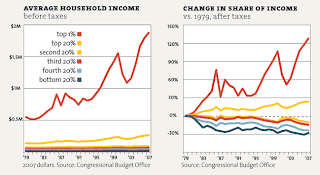
The DailyKos posted several times last year on income inequality and disproportionate benefits of proposed tax cuts, and here is a piece they linked to on income inequality. DailyKos also posted an excellent graph illustrating the deficit with and without tax cuts:

Source: Congressional Budget Office/DailyKos

They also posted this graph on the proportion of the deficit attributed to wars, tax cuts, TARP/recovery measures and the economic downturn itself.

Here is a WaPo graph from last year comparing who receives the benefits from the Bush tax cuts as compared with those originally proposed by Obama. Notably, this wasn’t a new topic in 2010; for example, the NYT wrote this in 2007 on tax cuts benefiting the wealthy. Bloomberg covered Warren Buffet on the wealthy paying more taxes and Newsweek wrote this a year ago on the topic. There is more on this subject from AmericanProgress.org.

Here’s another earlier article from Bloomberg on wealth inequity.

While on the subject of wealth inequity, I will add a note from my own personal experience. Early in my career, I worked on housing for the poor, and I remember it being a revelation to understand that many low-income people pay more for (often substandard) housing over the course of their lifetime than those who are much better-off and are able to own their own homes. This is because the poor have to pay rent every month of their life, and never build any equity. As onerous as 20-30 year mortgages can seem, there is an endpoint at which many mortgage holders will own their houses and the loan payments are done. If you are poor, rent is never done, until you die.

Corporate taxation: While these articles focus on individuals, the role of corporations in the shift of wealth and tax burdens is even more important. This recent Reuters article is about the number of corporations that don’t pay income taxes:

The Government Accountability Office said 72 percent of all foreign corporations and about 57 percent of U.S. companies doing business in the United States paid no federal income taxes for at least one year between 1998 and 2005.

More than half of foreign companies and about 42 percent of U.S. companies paid no U.S.income taxes for two or more years in that period, the report said…

Here are some other reports from truth-out.org and dailykos on this topic. I found that the trend was not new; there were very similar report findings from 2008, for example. Here is more information on the decline of corporate tax revenue and on the percent of federal revenue that comes from corporations.

graph: nationalpriorities.org

Unemployment: Shifting to unemployment, The Atlantic wrote about the “jobless economy.” I also found this reference to a WaPo article positing that a jobless recovery may not be bad. (This is what I mean by things being said that, a generation ago, would have been labeled as extremist positions, but now barely elicit a reaction.)

I also want to refer to Patrick’s excellent post on economic factors, including unemployment and long-term unemployment. This stubborn unemployment provides fertile ground to sow discord and to blame President Obama for not solving problems that he did not create and that have become structurally embedded in the “new economy.”

Firedoglake had this interesting post on the GOP's budget cuts being a "war on jobs" -- predicting the loss of 700,000 jobs. This is the information that Cantor is studiously ignoring.

Krugman worries about the unemployed.

Weakening worker protections, unions and regulations: The Repubs are very openly using the economic crisis as an excuse to weaken environmental and other regulations, and to challenge unions.

Representative Issa has extended an invitation to business to let him know what regulations they want to get rid of; this is also playing out at the state level.

Robert Reich criticized the Republican attack on regulations on HuffPo, and here is a piece on the Republican attack on carbon emission regulations.

Alternet (also here) and many other blogs are covering the attempt to weaken labor. Here is an article from Bloomberg disputing Scott Walker's claims about the public worker unions in Wisconsin.

The attempt to take away hard-won workers' rights is so highly charged, so publicized and so brazen that I am sure all our readers are well aware of it; I will leave more on this subject to other posts.

Weakening Social Security and other programs:

Krugman criticizes proposals to weaken Social Security.

“And having invented a crisis, what do Social Security's attackers want to do? They don't propose cutting benefits to current retirees; invariably the plan is, instead, to cut benefits many years in the future. So think about it this way: In order to avoid the possibility of future benefit cuts, we must cut future benefits. OK.”

Talkingpointsmemo also posted on the current efforts to weaken Social Security.

DailyKos posted this on a new proposal to change federal Medicaid reimbursements into block grants, which would "inevitably" result in reduced coverage and services.

Government spending priorities: Here is a link to the Center on Budget and Policy Priorities on the overall federal spending breakdown, and some basic information from Wikipedia on the U.S. military budget.

Privatization of profit and socialization of risk: Here and here are links on the privatization of profit and the socialization of risk. In this article, the same theme is specifically connected to Big Oil and energy. (I plan to write a post on “Big Oil,” including who gets the profits and who absorbs the risks, in the coming months.) I will go a step further, and suggest that the issue is not only the privatization of profit from private enterprise, but the privatization of profit derived from public dollars; think Halliburton.

Corporate control and consolidation of the media: Patrick and others have written on corporate control of the media, and specifically about the growing influence of the Koch Brothers and Murdoch’s News Corporation; I will not include links now on this topic here, but I expect it will be explored further on PoliticalGates. However, here is a reminder of legislation (1996 Telecommunications Act) that made this possible by weakening anti-trust legislation that had prevented monopolization of media markets, and some basics on the consolidation of the media; another overview on this topic, with links. MediaMatters is an excellent source on this topic, and has a page on financial issues as well.

A different model: I appreciated the NYTimes interactive feature where people could submit their own suggestions for reducing the deficit; based on my own attempts, it is quite feasible to do so through cutting military expenditures and raising taxes on corporations and the wealthy, while maintaining the funding needed to support social, environmental and other programs that benefit this country and its citizens. There is no need to cut Social Security, Medicaid and Medicare to balance the budget.

I thought I would also add to the "conversation" a positive alternative to an economy based on boom and bust cycles, externalization of costs and weakening of worker and citizen protections; this website promotes a different economic model that challenges many economic assumptions.

Conservative voices: As you can see, the sources I’ve referenced range from liberal to non-partisan. To hear directly from conservatives on this subject, I am also linking to a “Conservative Economics 101” piece from The American Spectator. Here is another of their articles, calling for eliminating the corporate income tax.

Of course, I am aware that many PoliticalGaters are fans of Andrew Sullivan, who has a different take on many of these issues as well. While I do not always agree with Andrew on economic issues, I respect his intellect and devotion to facts, and I welcome learning more about his and other reasoned positions backed by data. I agree that running up huge deficits is not good fiscal policy; however, I am more Krugmanian in regards to the need for economic stimuli to get the economy on solid ground before cutting spending; I am also strongly supportive of the wealthy and corporations paying a larger share of the total tax revenue. And, I cannot help but remember that we were running surpluses during Clinton's second term, and the so-called conservatives couldn't wait to get rid of those surpluses through both tax cuts and unaccounted-for-wars. That's why I tend toward a more cynical interpretation of their motives, that they are really more intent on bankrupting the government so that it cannot fund programs that benefit the lower- and middle-class.

In the big picture, I keep coming back to this realization: imagine that, 30 years ago, someone openly proposed such dramatic shifts in wealth, tax burden, weakening of unions and safety net programs. That would have been considered lunatic-fringe extreme (well, think Ayn Rand). Now, it’s mainstream extreme (and, I guess, so is she).

I also find myself asking what allows the Republicans to be so brazen. There’s a psychological aspect, I think – tied to authoritarianism, which I suppose makes it easier to wield power without concern for “the little guy” or the damage done to people’s lives. There’s dogma espoused by Ayn Rand and her followers. Obviously, the Koch Brothers’ funded Tea Party is part of the story, as Patrick has illuminated in prior posts. FOX distortions of the news is another part. The Citizens United decision is a new factor that has tilted the playing field even more than before, allowing more manipulation of public perceptions and dissemination of disinformation than was possible before. These are topics for another day.

As you see, I have just scratched the surface. There is much drilling to be done. But, as a starting point, have at it – what do you think of these ideas? It seems that it should be possible to pull the curtain away from these conservative strategies so that everyone can see what is happening; I really hope that the progressives, liberals, and the middle can work together more effectively to advance a more constructive economic and political agenda.

Update: I just found this new post on Mother Jones, with an excellent graph that is very relevant to this topic.

Monday, February 28, 2011

Western multinational corporations lobbied against collective bargaining rights in China, and failed: Betraying western values abroad

Guest Post by Nomadic Joe

China Blues: Capitalism, Corporations and Human Rights


Western corporations and economists regularly promote the idea that trade with China has had, and will have, a civilizing effect on the institutions there. As adjunct scholar Stuart Anderson writes:


“U.S. corporations act as a liberalizing force, helping to strengthen the private sector, establishing alternative centers of power, and creating subtle but important pressures for democratic reforms. They also tend to raise wages and labor standards in the countries in which they operate.”


Regardless of the merits of the statement, Anderson as a former director at the Cato Institute is hardly an unbiased scholar. The Cato Institute is a libertarian think tank headquartered in Washington, D.C. by Charles Koch, chairman of the board and chief executive officer of the oil conglomerate Koch Industries, Inc.


James A. Dorn, the vice president for academic affairs, editor of the Cato Journal, and director of Cato's annual monetary conference, observed:


Western companies have already had an impact on China's civil society. They have increased business standards and demanded a legal infrastructure. Continued economic liberalization is sure to raise business standards further and help cultivate an institutional infrastructure based on the rule of law. The changes will occur first in the non-state sector (especially in the southern coastal provinces) and then spread throughout China as competition and openness become the norm.


Progress is a pleasant idea. Moreover it is a nice favor for us to bring our profound concepts to the Chinese. However, given my suspicious mind, I couldn’t help wondering if there could be another side to it.

It is no great secret that corporations have been attracted to China mainly because of its nearly unlimited supply of cheap labor. In effect, labor becomes a national commodity and China plays a key role in setting global wage norms. As an article for the Institute for Policy Studies explains:


It is the linchpin of what Morgan Stanley chief economist Stephen Roach has called “global labor arbitrage” in which corporations move from one labor market to another to take advantage of cheaper labor. The result is a global “race to the bottom” in which workers and their communities are put into competition with each other to see who can provide the lowest-cost labor and the most corporate-friendly conditions. According to Roach, this global labor arbitrage is also now acting as “a powerful structural depressant on traditional sources of job creation in high-wage countries such as the United States.


That much has been understood for quite some time and it has led to CEOs decrying the fact that American workers are too demanding and require a higher wage than their Chinese counterparts. They argue that the excessive demanded organized labor has made the United States an undesirable place to do business.


Still, it seemed interesting that so many powerful groups would rise up against one particular reform bill.


‘Complicity, Campaigns, Collaboration and Corruption: Strategies and Responses to European Corporations and Lobbyists in China’, Globalization Monitor, published in 2010 exposed a slightly different, slightly sinister aspect.

Despite the professed concern for human rights in China, Western transnational corporations have been more than willing to relocate production. Moreover, they have actively used both their economic and political clout to work against proposed improvements to the Chinese labor laws. So while preaching the benefits of Western corporate involvement in China, EU and US corporations have been freely attempting to influence Chinese legislation.

Given recent events in Wisconsin, the methods are strikingly familiar.

A 2010 report from the Hong Kong-based NGO Globalization Monitor revealed how lobbying tactics have been adapted to Chinese circumstances and the concept of guanxi (connections or personal ties). Developing the personal touch with government agencies is of crucial importance, building trust and offering favours, which often crosses the line into full-blown corruption.


The American Chamber of Commerce (ACC) and the European Union Chamber of Commerce in China (EUCCC) have played a key role in lobby efforts. When the Chinese government sought to review its labor laws in 2006, primarily to introduce the right of workers to have contractual agreements, the two coalitions lobbied against any improvements in labor protections.


Acting through the American Chamber of Commerce in Shanghai, Wal-Mart and other corporations, including Google, UPS, Microsoft, Nike, AT&T, and Intel were squarely against the Draft Contract law.


US based corporations have repeatedly argued that they are raising human and labor rights standards abroad. For example, the American Chamber of Commerce in Hong Kong asserts among its “universal principles that American business plays an important role as a catalyst for positive social change by promoting human welfare and guaranteeing to uphold the dignity of the worker and set positive examples for their remuneration, treatment, health and safety.”


But US based corporations are trying to block legislation designed to improve the remuneration, treatment, health and safety, and other standards of Chinese workers.


Dr. Keyong Wu, an expert for the British Chambers of Commerce, stated:


Business is attracted to China not only because of its labour costs but also because of its efficiency. If regulation starts to affect that and flexibility, then companies could turn to India, Pakistan and South-East Asia.


A subtle threat for Chinese authorities? When international unions howled at the lobbying, the resultant media attention forced the European Chamber of Commerce to backtrack somewhat.


In a detailed report “Behind the Great Wall of China” Global Labor Strategies, a newly formed non-profit organization, undertook a closer examination into both the law and the corporations’ objections. Not surprisingly, they found that the protections found in the law under discussion were the very ones that would have made a real impact on the rights of workers.


For example, foreign corporations would prefer to maintain the present system which has created a large underclass of worker with no rights.

Access to labor rights and benefits—however limited—depends on the existence of a written labor contract signed individually or collectively by workers and companies.

Another provision of the law would have allowed workers greater ease in changing jobs. Before the law, an employer could penalize workers if their bosses determined that the worker had access to proprietary knowledge; secret information specific to the corporation, such as, chemical formulas and processes.


The problem, of course, is that the employer was free to decided what was and what was not “propriety.”


Among other provisions in the bill that the coalitions protested against included

  • Limited probationary period
  • Payment for training
  • Severance payments
  • A pathway from temporary to permanent work
  • A fair system for lay-off
And finally, there was one other interesting point of contention: The right of collective bargaining. The new law provides for negotiations over workplace policies and procedures, layoffs, health and safety,and firings with a union or an “employee representative.” Foreign corporations demanded unilateral authority, not negotiation.

The US-China Business Council writes, “It is not feasible to state that an employer’s regulations and policies shall be void if they are not adopted through negotiation with the trade union. . . . Requiring the consent of the trade union before such changes can be made is overly burdensome and may prevent important company policies from being implemented in a timely manner. . . Final authority and responsibility for company policies should rest in the hands of the employer.”


However, China’s legislature rejected the pleas and the threats from foreign investors and their lobbies and passed the new labor law in June of 2007 Still, the unions and independent observers agree that, due to the lobbying, the final laws were watered-down. In the end, regardless of the legislation on the books, the core problem will be enforcement and implementation.


Said Ellen David Friedman, a U.S. labor organizer who's worked with developing trade union groups in China, "U.S. corporations have used their considerable power and influence there to weaken the labor laws that are being proposed. They are in essence acknowledging that what they have liked about doing business in China is the very, very cheap labor and the low level of enforcement."


Since the law was approved, however, Chinese authorities seem intent on enforcing the protections. Surveys by Western chambers of commerce of executives show growing disenchantment in the last year and a sense that doing business in China is growing harder.


Along with the labor laws, China has also filed more than a dozen trade cases to limit imports, imposed a series of “buy Chinese” measures and limited exports of some minerals to force multinationals to move factories to China.

The multi-national executives have decided that the Chinese government was not so easy to intimidate. The executives are beginning to worry Chinese policy makers are becoming increasingly convinced that, given the shocks in the banking systems in the West in comparison to the expanding Chinese economy, Western policies of free trade and open markets do not work as well as previously thought, and that new industrial policies are worth trying. A New York Times article, regarding the concerns of foreign investors in China, states:


“They say, ‘Don’t show us broken models; we’re looking for a completely different way,’ and you see a much greater willingness to experiment with completely untested policies,” said a senior executive at a multinational who insisted on anonymity for fear of retaliation by Chinese regulators.


If China rejects this way of conducting business, the corporations have only themselves to blame. While preaching human rights and the glory of capitalism, the corporations, the executives and the lobbying groups have proved themselves betrayers of their own Western values. Article 23 of the Universal Declaration of Human Rights identifies the ability to organise trade unions as a fundamental human right, while item 2(a) of the International Labour Organization’s Declaration on Fundamental Principles and Rights at Work defines the “freedom of association and the effective recognition of the right to collective bargaining” as an essential right of all workers.


+++

Please re-tweet:


Saturday, February 26, 2011

Two Roads Diverged: Jimmy Carter’s Speech - July 15, 1979

Guest Post By Nomadic Joe

Background

The recent stunning images of revolution in the Islamic world is reminiscent of the Iranian revolution of 1978. Protests throughout Iran had led to the dethroning of the Shah of Iran and in his place, Ayatollah Khomeini- a fundamentalist cleric- became the leader of the nation.

The revolution had thrown oil production into decline and, this, in turn, had driven up prices.

*


To make up for this loss, Saudi Arabia and other OPEC nations boosted their respective production; however, the cartel had also announced that a series of oil price increases would accompany this increase. Gasoline prices skyrocketed and the perception of a shortage had led to widespread panic. Beginning in California and spreading eastward, the panic soon turned to anger from the American public and this hostility was primarily directed at the Carter administration. One of reason for this was Carter’s decision to cut all imports of Iranian goods, following the seizure of American hostages when students raided the American embassy in Tehran.


Carter's approval rating had dropped to 25%, lower than Richard Nixon's during the Watergate scandal. Following an exhausting summit in Tokyo, the one thing President Carter desired most was a break. He had planned to travel to Hawaii for a vacation. However, his chief of staff took a look at the poll numbers and warned him that his chances of re-election would be in serious doubt unless he took some action immediately.

Reluctantly, he cancelled his vacation and retreated to Camp David to begin working on a speech to the nation regarding the energy crisis. His heart was conflicted. His other speeches had had limited effect and he had begun to feel that the public had simply stopped listening. He now felt that a new approach was necessary.


*

Casting aside his previous plans- much to the concern of his staff- Carter privately invited dozens of prominent Americans to Camp David- members of Congress, governors, labor leaders, academics and clergy- to speak their minds about the present state of the nation. Carter sat on the floor and took notes while citizens from all walks of life shared their opinions with the leader of the country.


What Carter heard was not flattery but valid, honest criticism of his leadership. For Carter, this “domestic summit” was enlightening and the things he had learned directly from the voters offered him a new direction for the nation.


The speech was given on a Sunday evening of July 15, 1979. Millions of Americans watched as Carter gave what was to be his most important speech. I recall the speech and looking back on the online video copies of it now, it is faintly embarrassing. Carter was not at all a smooth speaker and in some ways, his corniness was part of his appeal. In the years following Watergate, the public had grown intensely frustrated with career politicians and yearned for an outsider. Compared to Carter’s successor, Jimmy Carter’s manner of public speaking was unnatural, his gestures forced and awkward. As one of his speech writers, Hendrik Hertzberg, remarked, “[it] was more like a sermon than a political speech. It had the themes of confession, redemption, and sacrifice. He was bringing the American people into this spiritual process that he had been through, and presenting them with an opportunity for redemption as well as redeeming himself."


Speech

Though he never used the word, it became known as Carter's "malaise" speech. That, then, is the background of the speech and here are some excerpts.


We've always believed in something called progress. We've always had a faith that the days of our children would be better than our own.


Our people are losing that faith, not only in government itself but in the ability as citizens to serve as the ultimate rulers and shapers of our democracy. As a people we know our past and we are proud of it. Our progress has been part of the living history of America, even the world. We always believed that we were part of a great movement of humanity itself called democracy, involved in the search for freedom, and that belief has always strengthened us in our purpose. But just as we are losing our confidence in the future, we are also beginning to close the door on our past.


In a nation that was proud of hard work, strong families, close-knit communities, and our faith in God, too many of us now tend to worship self-indulgence and consumption. Human identity is no longer defined by what one does, but by what one owns. But we've discovered that owning things and consuming things does not satisfy our longing for meaning. We've learned that piling up material goods cannot fill the emptiness of lives which have no confidence or purpose.


The symptoms of this crisis of the American spirit are all around us. For the first time in the history of our country a majority of our people believe that the next 5 years will be worse than the past 5 years. Two-thirds of our people do not even vote. The productivity of American workers is actually dropping, and the willingness of Americans to save for the future has fallen below that of all other people in the Western world.


As you know, there is a growing disrespect for government and for churches and for schools, the news media, and other institutions. This is not a message of happiness or reassurance, but it is the truth and it is a warning.


These changes did not happen overnight. They've come upon us gradually over the last generation, years that were filled with shocks and tragedy.


We were sure that ours was a nation of the ballot, not the bullet, until the murders of John Kennedy and Robert Kennedy and Martin Luther King, Jr. We were taught that our armies were always invincible and our causes were always just, only to suffer the agony of Vietnam. We respected the Presidency as a place of honor until the shock of Watergate.


These wounds are still very deep. They have never been healed.


The gap between our citizens and our Government has never been so wide. The people are looking for honest answers, not easy answers; clear leadership, not false claims and evasiveness and politics as usual.


What you see too often in Washington and elsewhere around the country is a system of government that seems incapable of action. You see a Congress twisted and pulled in every direction by hundreds of well-financed and powerful special interests. You see every extreme position defended to the last vote, almost to the last breath by one unyielding group or another. You often see a balanced and a fair approach that demands sacrifice, a little sacrifice from everyone, abandoned like an orphan without support and without friends.


Often you see paralysis and stagnation and drift. You don't like it, and neither do I. What can we do?


First of all, we must face the truth, and then we can change our course. We simply must have faith in each other, faith in our ability to govern ourselves, and faith in the future of this Nation. Restoring that faith and that confidence to America is now the most important task we face. It is a true challenge of this generation of Americans.


We are at a turning point in our history. There are two paths to choose. One is a path I've warned about tonight, the path that leads to fragmentation and self-interest. Down that road lies a mistaken idea of freedom, the right to grasp for ourselves some advantage over others. That path would be one of constant conflict between narrow interests ending in chaos and immobility. It is a certain route to failure.


And Afterward

Surprisingly perhaps, his poll numbers went up 11 percent the day after the speech. That glow was short-lived, however. Carter didn't help himself by clumsily conducting a shakeup of his government in the week following the speech. That decision, too, came directly from the opinions he had collected about the loyalty of his staff. This ill-timed house-cleaning of his cabinet, so late in his term, suggested that things were in a state of collapse. His vice-president, Walter Mondale recalls, “ the message the American people got was that we were falling apart."


*

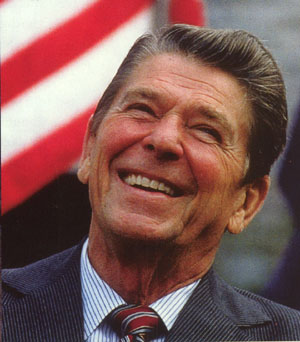
The Republican side clearly saw an opportunity. Ronald Reagan offered a vision of America without limit whose glory lay before it. A little more than a year later, Ronald Reagan defeated Carter by offering Americans a vision that was as optimistic as Carter's was pessimistic. Americans have always been a positive people and Reagan, whatever his true record, made Americans feel good about themselves. The Neo-Conservative movement adroitly used the phrase “a crisis of confidence” to mean “weakness.” Re-reading the text of the speech shows this was not quite what Carter was actually referring to. However, the label stuck tight and that is what historians now use to define the Carter years.


Admittedly, Reagan was, unlike Carter, a master of rhetoric and the smooth delivery. His old style patriotism was a political masterpiece, delivered by the idealized grandfather.

In his book, Limits of Power, Andrew J.Basevich notes:


No doubt Reagan spoke from the heart, but his real gift was a canny knack for telling Americans what most of them wanted to hear. As a candidate for the White House, Reagan did not call on Americans to tighten their belts, make do, or settle for less. He saw no need for sacrifice or self-denial. He rejected as false Carter’s dichotomy between quantity and quality. Above all, he assured his countrymen that they could have more.


But as Basevich also points out, there is a cost to unlimited demand A life without restrictions or sacrifice necessarily requires an ability to control the resources that underpin it. As an political policy, this, unfortunately, demanded an imperial approach. If Mubarak tortured his own people, denied them free elections and squashed any and all dissent, then at least, he was “ours.” He was, we assumed (incorrectly)- somebody we could rely on. If the strong man approach did not work, then the use of force was always available. This, however, requires an expensive modern military, ready to secure our resources, under the guise of protecting our “national interests.”

In a excellent article regarding the speech, author and history teacher at Ohio University Kevin Mattson observes:


The other way to understand the speech is to see it as a turning point. The age of conservatism....has been framed not by Carter’s tones of humility but celebratory nationalism. In fact, the game plan was laid by Ronald Reagan’s direct retort to Carter, made when announcing his candidacy just three months after Carter’s speech. Reagan explained, “I find no national malaise. I find nothing wrong with the American people.” Instead America stood as a “shining city on a hill,” a term he used persistently throughout the campaign.


Where did this talk of positive thinking take us? Well, triumphant confidence can become dangerous. It can lead Americans to questionable ambitions overseas, to think of themselves as leading the world and unwilling to scrutinize their own values or ask any questions about themselves.


Carter’s speech reminds us that a leader can ask something of the American people and can tell citizens they have grown too comfortable in their ways and must face some uncomfortable truths about the perils of their way of life. It shows that a leader can speak boldly to the American people about their problems and can in fact re-energize the civic bonds between leader and citizens. The “malaise speech,” as it’s unfortunately titled, didn’t necessarily show exactly how we would get off our reliance on fossil fuels today. But it did suggest that we would become better – not just environmentally but morally – if we did.


So much of what Carter warned the American people about has now come to pass and so much of it is related to our dependence on petroleum. This, in turn, drives an economy designed, for the most part- to support a way of life we did not actually need and could not afford. The attitude throughout the last decade of the last century was: Too much was not nearly enough. And there may not be anything wrong with that if it had been a reward for our hard work but instead, it has all been constructed on a false sense of entitlement.


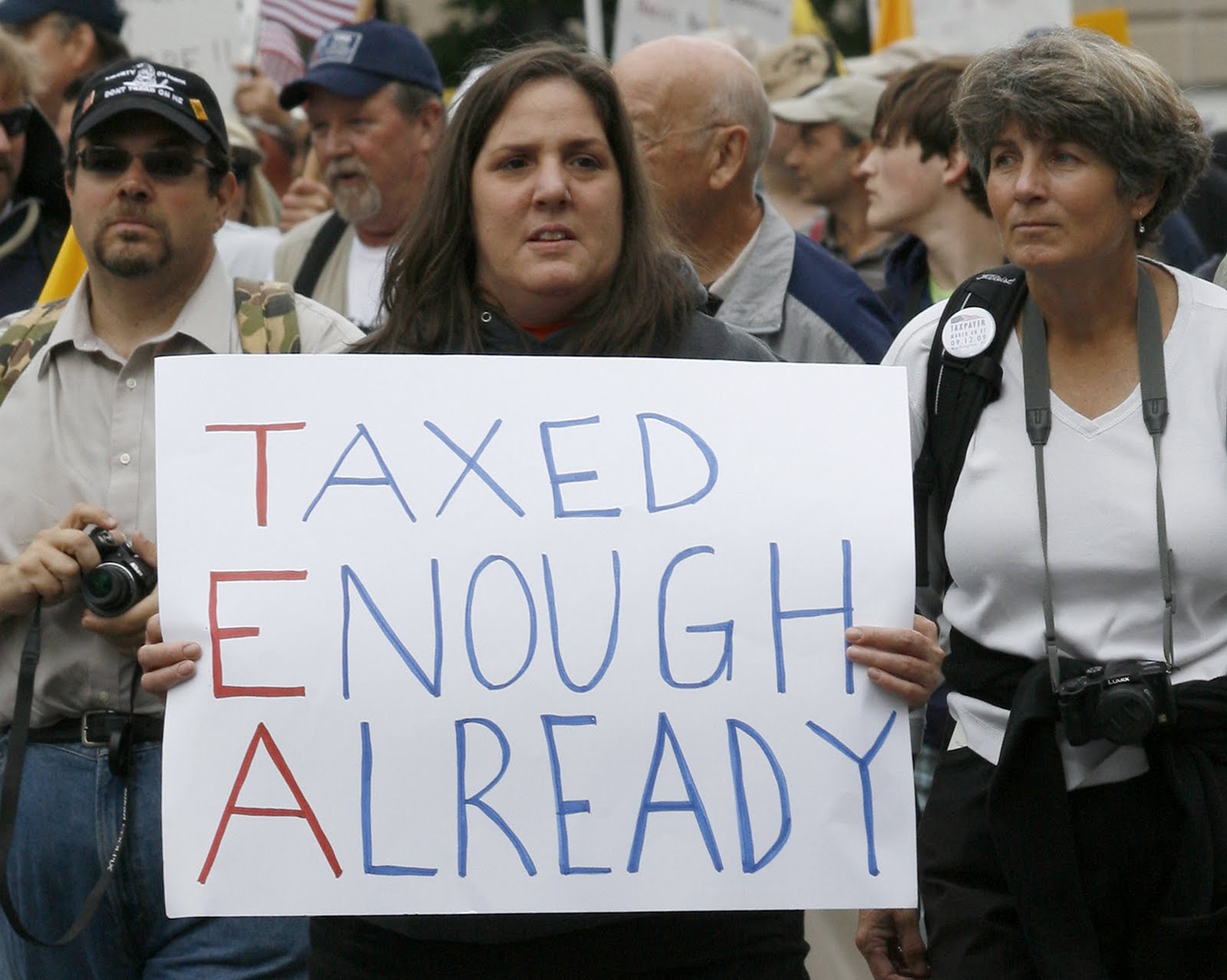
Unlike the social movements of the 1960s whose goals were diversity and a sharing of the American pie, The Tea Party movement appears to advocate a defense of the entitlements that certain citizens have come to expect. This essentially selfish philosophy, fully financed by corporations, and regaled by the bellowing voice of Murdoch, has become “The New Patriotism.”

*


As another blogger has astutely pointed out:

I think Reagan's ultimate legacy will be that we now have a generation of people that have been raised to believe that the government can provide all sorts of services (police and fire departments, schools, hospitals, national defense, health care, etc) and no one has to pay a dime for it. We have a generation of adults who believe they shouldn't have to make a single sacrifice in order to benefit from all the services that the government offers. In fact, some believe that their taxes should be cut even further or eliminated all together.


This makes getting out of the current mess altogether more difficult. Politicians who propose raising taxes and/or cutting government services have a hard time getting elected and those in power who do so usually don't get re-elected.


The testing of the soul of America seems to be in full swing, as much now as it was when Carter made that speech on a summer night more than thirty years ago.