Showing posts with label internet kill switch. Show all posts

Saturday, February 5, 2011

Suppression and intimidation of the media: It’s not just Egypt

By Blueberry Tart


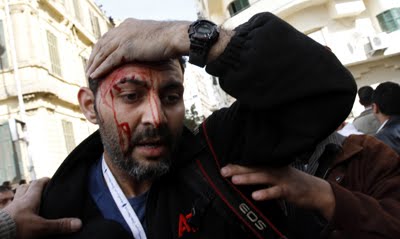
AP photographer Khalil Hamra is injured in Tahrir Square on Thursday. (AP Photo/Mohammed Abed from cpj.org)

Egypt is fast becoming one of the world’s most visibly barbaric examples of suppression and intimidation of journalists who are trying to provide on-the-scene reports of a popular uprising to the watching world. The Egyptian police’s Gestapo-like tactics in trying to silence the press is also a warning to us all about the threat to democracy when freedom of the press is lost or compromised.

Here is a report from the Committee to Protect Journalists on what is going on in Egypt to silence the media.


“Journalists in Cairo faced assaults, detentions, and threats again today as supporters of President Hosni Mubarak continued their efforts to obstruct news coverage of protests demanding the Egyptian leader's ouster. While the extent of attacks lessened after a peak on Thursday, ongoing anti-press activities remain at an alarming level that must be halted, the Committee to Protect Journalists said today. In addition, a journalist shot a week ago while filming a demonstration died today, a state newspaper reported…

Just in the last 24 hours, CPJ documented another 10 anti-press assaults, eight detentions, two attacks on newsrooms, and the hacking of a major news website. In all, CPJ has documented at least 101 direct attacks on journalists and news facilities this week, and it's investigating numerous other reports.”


The BBC also showed scenes of its reporters being mobbed and threatened, as did CNN’s Anderson Cooper, who also wrote this:


“…we would like to be showing you pictures, live pictures, of what's happening in Liberation Square right now, but we can't do that because our cameras have systematically been taken down through threats, through intimidation, through actual physical attacks…

I don't mind telling you I am a little bit scared, because we frankly don't really know what the next few hours will hold. And I think there's a lot of people who are scared tonight in Egypt."


These tactics, combined with the internet kill switch described in Kathleen’s earlier post, are the Egyptian government’s desperate and brutal attempt to keep the whole world from watching. Thankfully, they are failing. Images of what is going on are still getting out and being broadcast around the world; this is critical. The world’s outrage against the regime’s brutality is palpable. This ability to bear witness and to gain public attention is a key element of the non-violent resistance campaigns used so successfully to overcome injustices by Mahatma Gandhi, Rev. King and others. Whether it will be enough to effect reform in Egypt in the near term remains to be seen, but without the world’s witness, I think it is obvious that repression of the protests would be even more brutal and successful protest more unlikely.

These brutal tactics against journalists are becoming the norm during popular uprisings against violent regimes, and also in cases where journalists dare to delve into the underbelly of corrupt societies. They usually don't garner so much attention. Veronica Guerin in Ireland and Anna Stepanovna Politkovskay in Russia are two cases of reporters who tackled corruption and paid with their lives, and whose stories were reported internationally; but the International Federation of Journalists has documented 300 murders and disappearances of journalists in Russia alone since the early 1990s.

These images also caused me to think about erosion of freedom of the press in the United States. Remember the shocking incident last fall, when an editor for the Alaska Dispatch was forcefully detained by Joe Miller’s security goons? Rarely is intimidation here quite so brazen and overtly threatening, but it is nevertheless growing as a successful tactic to stifle full and honest reporting of the facts. Subtle intimidation is more pervasive, and probably more effective (we saw that Joe Miller’s bullying tactics backfired). As we have seen more frequently, the American media has fallen victim to another method of being silenced: the propagandizing of the right-wing controlled media, combined with the intimidation of mainstream media outlets that are too cowed to fully investigate and report the truth about how policies, politicians, power and power-brokers are manipulating the public and mischaracterizing the public interest.

Nowhere is this truer than in the misinformation about going to war in Iraq and Afghanistan, the hysteria about “Obamacare” and “death panels,” and deficit-hawkish legislators voting for tax breaks for the wealthiest Americans. Yet it happens so pervasively, even on less momentous issues. Remember how Time Magazine reported for a cover story on Palin, based on emails she sent? Or how often her own statements have been reported as truth, without any corroborating evidence or even legitimate inquiry? This is how she has been “enabled.” Remember the “journolists” scandal that surfaced for a day or two, revealing that those journalists who questioned Palin’s implausible birth story were intimidated into not following up and reporting on their suspicions or the huge discrepancies in her often conflicting stories? This is more of the deliberate manipulation of the media. Instead of rifles, water cannons, handcuffs, the weapons of choice are discrediting factual reports and honest reporters, accusations of media “liberal bias,” disinformation and distractions.

The possible combination of media suppression and government control of the internet is especially chilling. The importance of the new, grassroots media, including its newest star, Politicalgates, is especially important to ensure that we can continue to provide the information the public needs to make good decisions about our collective future.


Saturday, January 29, 2011

Civil unrest continues in Egypt - Will there be an "internet kill switch" in the USA's future?

By Kathleen

I had hoped by now that the civil unrest that is taking place in Egypt might have calmed down. It hasn't. Since Tuesday it has been estimated that approximately 100 people have been killed and the unrest continues to escalate.

On Friday the government shut down internet and telephone services. The services were blocked from receiving signals in a bid to suppress images and posts from revealing the full extent of the anti-government protests. You can see from the following graphic how the internet in Egypt suddenly "died" on January 27, 2010:

Egypt internet traffic

(h/t to our reader "nomadicjoe, who runs the blog "A Nomadic View" and published a post about this subject)

Despite the protests Hosni Mubarak refuses to step aside leading to tens of thousands of protesters congregating in the streets calling for his resignation and burning images of him. Earlier they ignored night curfew limits and attacked police vehicles, setting them on fire. The military were brought in to control the crowds and patrol the streets and the numbers killed rose dramatically. Despite the rising death toll the demonstrators are determined to stay until Mubarak steps aside.

Many western leaders have called for reform including President Barack Obama who called upon the Egyptian authorities to "refrain from attacking the protesters" and further added "those protesting in the streets have a responsibility to express themselves peacefully". He also stated that:

"Now, going forward, this moment of volatility has to be turned into moment of promise. The United States has a close partnership with Egypt and we've cooperated on many issues, including working together to adbance a more peaceful region. But we've also been clear that there must be reform -- political, social, and economic reforms that meet the aspirations of the Egyptian people."

President Obama also told the Egyptian government to "reverse the actions that they have taken to interfere with access to the Internet, to cell phone services and to social networks that do so much to connect people in the 21st century".


Coincidently, according to news reports, a bill was in the process of being floated by Senator Susan Collins, the Republican ranking member on the Homeland Security and Governmental Affairs Committee, which would grant the President similar internet killing powers.

According to wired.com, an aide to the Homeland Security committee described the bill as one that does not mandate the shuttering of the whole internet. Instead, it would authorize the president to demand turning off access to so-called "critical infrastructure" where necessary.

It seems clear to me that "critical infrastructure" can be interpreted to mean just about anything that the Government may want it to mean. If this legislation is passed Americans may wake up one morning to find their internet is no longer available to them and that their phone has stopped ringing.

The discussion about an "internet kill switch" in the USA has been stirred up by the events in Egypt. Dan Costa, Executive Editor of "PC Mag", commented on January 28:

"The U.S. telecommunication industry is much more complex and far more decentralized. To do something similar in the U.S. would require a lot more than four phone calls. There are simply too many connections inside the nation already for them to be silenced. Also, since our economy is more dependent on the Internet obstructing the free flow of information would be disastrous. Still, the push for a U.S. Internet Kill Switch is here, but no one understands the consequences.

The fact is, no one in the U.S. should ever have the right or the ability to take the Internet offline. As an editor of a purely online publication (we made the switch from print a few years ago), it's very clear to me that freedom of the press relies more than ever on the Internet. No one in the U.S.—or anywhere—should have the right to shut it down."

CBS reported about the internet shut down in Egypt in the protests:


It is clear that Egypt is in turmoil and that the problems there may only be settled by the people via free and democratic elections. How likely is this to take place? Mubarak shows no signs of leaving Egypt despite being advised to do so by the powerful Arab Cleric Yusuf al-Quaradawi cleric of the Muslim Brotherhood. It seems that until Mubarak leaves there will be no peace. And whilst Mubarak stays the violence will continue and more people will be killed or seriously injured.

"The Daily Dish" provides excellent "live" reporting about the situation in Egypt.

+++

Please re-tweet:

.